
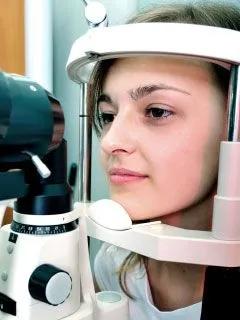
Eye Exam and Consultation
During an eye exam, Dr. Marcie Lerner will ask you questions about any symptoms or issues you are experiencing, medications you are currently taking, any blurry vision, your work environment, and your overall health. Family history and previous eye or vision conditions will also be discussed during this part of the examination. Dr. Lerner will consider this information when determining any treatments or recommendations.
Vision Testing
Regular vision testing and evaluations ensure that you always have the clearest vision possible. Dr. Lerner provides regular vision acuity test as part of a comprehensive eye exam. Dr. Lerner will measure how each eye is seeing by using a digital eye chart and a reading eye chart. The results of these tests are portrayed as a fraction, with 20/20 being the standard for normal distance and reading vision. Depending on the results of your vision test, Dr. Lerner may prescribe corrective glasses, contacts, or eye exercises, and perhaps LASIK.
Eye Function Testing
In addition to vision testing, an eye exam in our Bethesda office includes testing eye functionality. Our optometrist performs several tests to evaluate depth perception, color vision, eye muscle capabilities, peripheral vision, and responsiveness to light. Several other simple tests are completed to determine whether the eyes are focusing, moving, and working together properly. The test results enable Dr. Lerner to diagnose any underlying conditions that may be impairing the eyes ability to focus or work together.
Eye Health
As part of a comprehensive eye exam, our optometrist examines the overall health of the eye through a visual examination and tonometry. Dr. Lerner evaluates eye health by visually inspecting the eye and eyelids using a biomicroscope. To examine the internal structures of the eye, we may dilate the pupils. Increased eye pressure may be an indicator of glaucoma, so we utilize tonometry to measure eye pressure. After completing these short tests, Dr. Lerner reviews the results and discusses any necessary treatment options with you. Contact us at (301) 913-0293 today to schedule a comprehensive eye exam.
Supplemental Testing for Ocular Health Evaluation (see below):
The Optomap Retinal Exam:
The Optomap is a retinal imaging device that takes digital images of each eye creating a large view of the retina without the need to use eye drops. Sometimes, we would advice BOTH dilation and optomap for a more thorough exam, especially to further examine patients with diabetes, glaucoma, or advanced cataracts.
The retinal imaging has the following advantages:
· Fast, easy and comfortable
· We can see 200 degrees of the back of the eye vs. the 30 degrees seen during a non-dilated view of the back of the eye.
· We have a photographic record with which to compare and track potential eye disease.
For more information about the Optomap, visit https://www.optos.com/patients
Visual Field Exam:
The visual field allows us to pick up and diagnose conditions such as some forms of brain tumors, retinal detachments, glaucoma, macular degeneration, optic nerve disease, retinal infections, and other diseases and disorders. It is fast, inexpensive, accurate, and may pick up conditions that are not always evident by looking inside the eye so it is an excellent adjunct to the Optomap.
Fees: There is an additional charge of $40.00 for the Optomap retinal exam and $30.00 for the visual field exam. If you select both tests, the fee is reduced to $55.00 TOTAL.
These fees are in addition to the regular exam fees.
Because your insurance is designed to cover only a basic eye exam, it does not usually cover advanced screening such as the Optomap or the visual field.
